


A military brand Barbaric plastic compass with magnifying glass and navigation capabilities.
A compass consists of:
- The compass needle
The compass needle is divided into two colors. The white part points south and the red part always points north.
Interesting fact: a compass also works underground. In a mine shaft, for example.
- The rose
The compass rose is a rotating ring with a division on it. This can be in 360 degrees or in 6400 mills for military use. Along with the compass rose, the lower surface rotates. On this are two red bars.
- The base plate
The baseplate always has at least one straight side and an arrow. This arrow is always the direction of travel.
A compass can be used in conjunction with a map and map angle meter.
Using a compass without a map
Suppose you need to walk 500 meters in the direction 320 degrees.
Method:
- You turn the compass ring so that the mark 320 on the compass ring is flush with the arrow on the base plate.
- Then you turn the whole compass, not the ring until the red part of the compass needle is exactly straight between the red bars on the bottom surface.
- After this, the arrow on the base plate indicates the direction of travel.
- You do not readjust the compass until the target is reached.
Using a compass with a map and map angle meter
Using a map angle meter is highly recommended because in this case the map does not need to be pointed north.
The map angle meter
- place the map angle meter with its center (the beginning of any cord) at the spot where you are.
- Take the end of the string and place it exactly on or over the target.
- Then read the ring
- Then set the compass to the direction as described in using a compass without a map.
Using a compass with a map without a map angle meter
If you do not have a map angle meter and still want to set a direction to a target you must first lay the map north, or orient to north. The thin lines on the map running from top to bottom indicate the north-south line.
Make sure the map is completely flat to allow the compass needle to rotate freely.
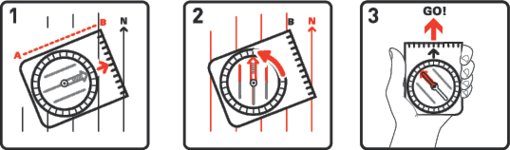
Set the compass so that the N (north , or zero or 360 degrees / 6400 mills) is at the arrow on the baseplate.
- Place the compass with the long side along one of the thin lines that run on the map from top to bottom
- Turn the whole thing, the map with the compass on it until the red part of the compass needle is between the red bars on the bottom surface.
- Now the map is oriented north. This is the starting position for plotting a direction on a map without a map angle gauge.
- Leave the map lying and take the compass
- Place the compass with the long side along the point where you are standing and along the target you want to go to.
- If the distance on the map is greater than the compass, estimate the direction as best you can.
- Now hold the compass firmly in place and turn only the compass rose until the red part of the compass needle is exactly straight between the red bars on the bottom surface.
- You have now plotted the direction of travel to the target.
Cross poll
In the previous explanation, you knew where you were. Suppose you don't know this. Then it is possible to use a compass and a map to determine your location.
- You look for at least two prominent points in the terrain that you can find on a map. For example, a church tower, a windmill, or a bridge.
-Shoot the direction from those two landmarks. You do this by pointing the compass to that landmark. With a mirror compass, if you set the mirror correctly, you can now read the degrees in the mirror. Transfer this direction to the map. Then do the same with another landmark point. More landmark points? Fine. You now have two (or more) lines on the map. At the intersection of those lines you are now.
When cross-peering, it is important to work very accurately.
Declination
You may have heard of declination. This is the difference between map north (north on the map), true north (geographic) and magnetic north to which the compass needle points. To complicate matters, that magnetic north continuously changes position and the deviation from north is not the same everywhere. On average, the difference is 4 degrees. So true north is (usually) 4 degrees to the right of what your compass indicates. You can get very complicated about that, but I would save that until when you're looking for that one little oasis in the Sahara, or something like that. At the relatively short distances you have to deal with in our part of the world, it doesn't play such a big role. At a distance of a kilometer you have to count on a deviation of 40-50 meters.
These are just the elementary principles of compass work. If you want to know more about this subject it is best to buy a good book about it. Take that, a topographic map, outside and start practicing. First on familiar terrain, later on unfamiliar terrain.